
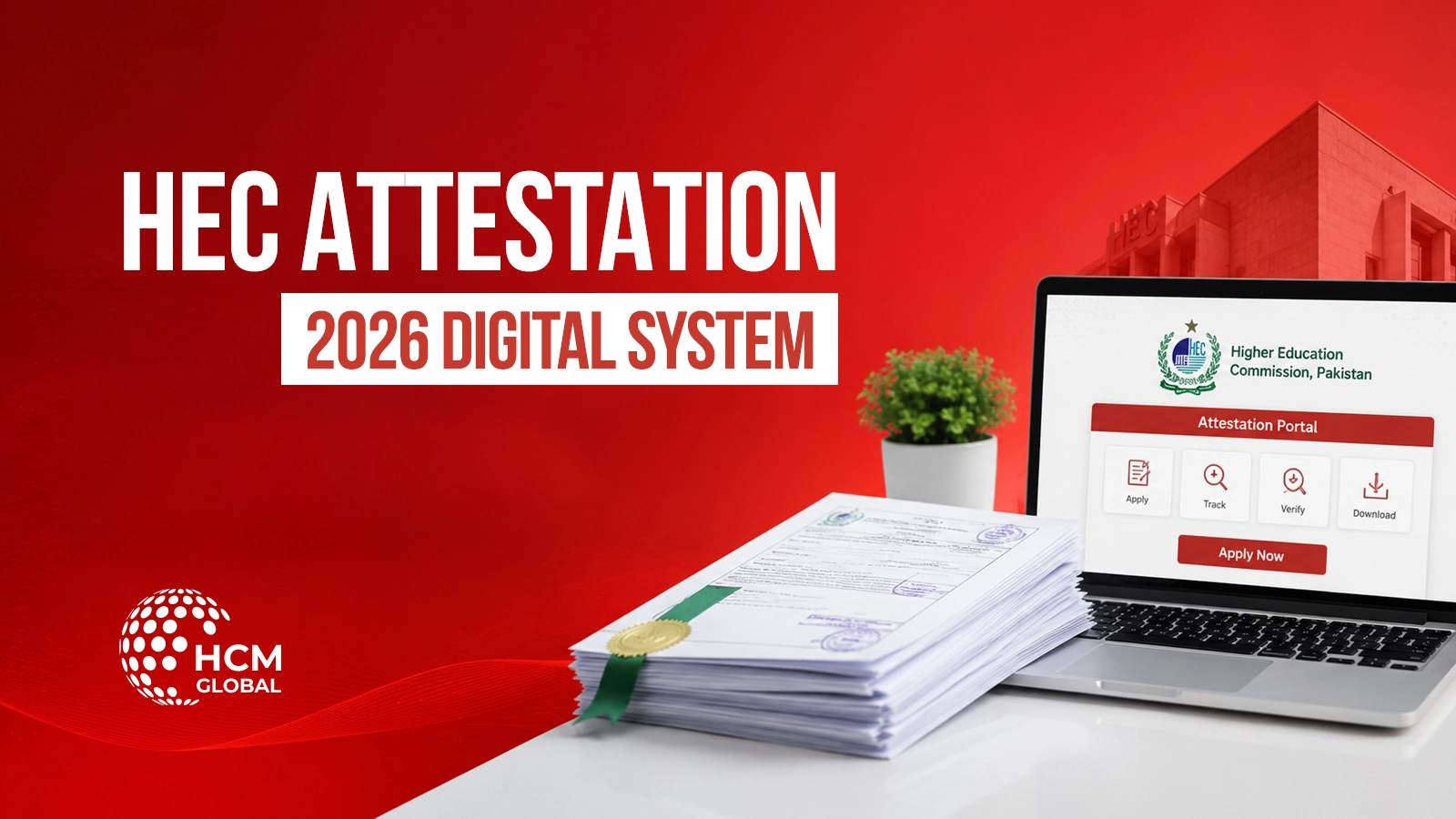
If you just finished your degree and you’re planning to work or study abroad, HEC attestation is the first thing you need to sort out — and in 2026, the process has changed significantly. The Higher Education Commission launched a fully digital, paperless Degree Attestation System (DAS) in May 2026, replacing the old in-person and courier-based method entirely.
This guide covers everything a fresh Pakistani graduate needs to know about HEC attestation in 2026 — what the new system is, how it works step by step, what documents you need, the updated fees, timelines, and the mistakes that will slow you down. Whether you’re heading to the UAE, Saudi Arabia, the UK, Canada, or anywhere else, this is your starting point.
What Is HEC Attestation?
HEC attestation is the official process by which the Higher Education Commission (HEC) of Pakistan verifies and authenticates your educational documents. When HEC attests your degree or transcript, it confirms that your qualification is genuine and was issued by a recognised institution.
It’s the mandatory first step in the full document attestation chain. No embassy in Pakistan will touch your educational documents until HEC has verified them first. After HEC comes MOFA (Ministry of Foreign Affairs), and then the relevant embassy of your destination country. Miss this step and the entire chain breaks down.
HEC attestation applies to university-level qualifications — Bachelor’s degrees, Master’s degrees, PhD degrees, and their transcripts. For Matric (SSC) and Intermediate (HSSC) certificates, you need IBCC attestation instead.
What Changed in 2026? The New HEC Digital Attestation System
This is the biggest update to HEC attestation in years, and every fresh graduate needs to know about it.
On 11 May 2026, HEC Chairman Dr. Niaz Ahmad Akhtar officially announced the launch of the revamped Degree Attestation System (DAS) — a fully online, paperless platform built on blockchain technology, developed in partnership with CMPak (Zong) and Wibbow Technologies.
Here’s what changed:
- No more office visits. You no longer need to travel to HEC regional centres in Islamabad, Lahore, Karachi, Peshawar, or Quetta.
- No more physical document submission. You don’t courier your originals anywhere. Everything is uploaded digitally.
- No more physical stamp. Instead of an ink stamp on your degree, HEC now issues a verifiable e-Attestation Certificate (e-certificate) that you download from your portal account.
- Available 24/7. Applications can be submitted anytime through the HEC e-Services Portal at eservices.hec.gov.pk.
- Blockchain-secured. The e-certificates use blockchain technology, which means foreign institutions and employers can verify them instantly online — making them more credible internationally, not less.
Important note for those with pending old-system applications: If you already submitted your application and paid the fee under the old system, you still get processed — but only until 30 June 2026. After that date, all processing shifts to the new system. If you started an application in the old system but haven’t paid yet, switch to the new portal now.
If your degree was attested before May 11, 2026, your old stamp remains fully valid. You don’t need to redo anything.
Why Does a Fresh Graduate Need HEC Attestation?
If you’re a Pakistani graduate and you want to:
- Apply for a work visa to the UAE, Saudi Arabia, Qatar, Oman, Bahrain, or Kuwait
- Enrol in a Master’s or PhD programme at a foreign university
- Apply for immigration to Canada, Australia, or the UK
- Submit documents for WES (World Education Services) evaluation
- Get your credentials accepted by a foreign employer
…then HEC attestation is non-negotiable. It’s not a formality — it’s a hard requirement. Without it, no embassy will process your educational documents. Many fresh graduates find this out too late, after they’ve already accepted a job offer abroad with a tight joining date.
Documents Required for HEC Attestation (2026)
Under the new system, everything is uploaded digitally. No photocopies, no courier, no originals being handled by strangers. You’ll need clear, high-resolution scans of the following:
Academic documents (upload from Matric onwards):
- Matric (SSC) certificate
- Intermediate (HSSC) certificate
- Bachelor’s degree (or Master’s, whichever you’re attesting)
- Detailed Mark Sheets / Transcripts
- Provisional certificate (if applicable)
Identity document:
- CNIC (or Passport if you’re abroad)
Critical rule: Every detail on your documents — your name, father’s name, date of birth, university name, degree title, graduation year — must match your CNIC exactly. Even a single spelling difference will get your application flagged.
Step-by-Step: How to Apply for HEC Attestation in 2026
The new system has streamlined everything into five main steps:
Step 1: Register on the HEC Portal
Go to eservices.hec.gov.pk and create an account using your CNIC number and a valid email address. Use an email you check regularly — all status updates, verification confirmations, and your final e-certificate will come through here.
Step 2: Build Your Academic Profile
After logging in, complete your personal details and your full education history from Matric onwards. This is where most errors happen. Double-check every field — degree title, university name, session, roll number, graduation year. Any mismatch with your actual documents will cause a rejection.
Step 3: Upload Your Documents
Upload high-resolution scans of all your academic documents and CNIC. The portal accepts PDF and JPEG formats. Blurry, cropped, or low-quality scans are rejected automatically. Invest in a proper scan — phone photos taken at an angle are not enough.
Once uploaded, the system automatically forwards your documents to your university’s verification desk. Your university checks the records electronically and confirms your degree is genuine.
Step 4: Pay the Attestation Fee
After your university confirms your records, a payment link is generated in your portal account. A Consumer Number appears automatically when you click “Proceed for Payment.”
Pay online through:
- 1-Link (1-Bill)
- Debit or credit card
- Mobile wallet
The fee must be paid online. There is no bank challan or cash counter visit anymore.
Step 5: Download Your e-Attestation Certificate
Once payment is confirmed and HEC completes its final review, you receive an SMS and email notification. You then log in to your portal and download your e-Attestation Certificate directly. This is your official attested document — blockchain-secured and verifiable online by any institution worldwide.
HEC Attestation Fee in 2026
The fee structure has been updated alongside the new system:
| Document Type | Fee (2026) |
|---|---|
| Degree (original) | Rs. 3,000 per document |
| Transcript / DMC | Rs. 3,000 per document |
| Provisional certificate | Rs. 3,000 per document |
| HEC Equivalence Letter | Rs. 3,000 per document |
The fee is Rs. 3,000 per document — up from Rs. 1,000 under the old system. HEC has confirmed that a portion of this fee goes directly to universities to cover the cost of digital record verification.
While the upfront fee is higher, the total cost for most applicants is actually lower now. Under the old system, you also paid for travel to a regional centre, photocopies, courier services (which could run Rs. 1,500–3,000 alone), and sometimes accommodation if you were coming from another city. All of that is now eliminated.
How Long Does HEC Attestation Take in 2026?
Processing times under the digital system are expected to improve significantly. Based on how the system works:
- University verification: Typically 5–8 working days (HEC forwards documents digitally to your university)
- HEC final review: 3–5 working days after university confirmation
- Total estimated time: 10–15 working days for most applicants
Pro tip: Start this process at least 4–6 weeks before you need your documents. University verification speed varies — some institutions respond within days, others take longer. The biggest bottleneck is usually your university’s records department, not HEC itself.
Common Mistakes That Cause Delays or Rejections
These are the errors that affect the most applicants — avoid them:
- Name or date mismatches. Your name on your degree, transcript, and CNIC must be identical. A difference in spelling (e.g., “Muhammad” vs “Mohammed”) will get your application flagged. Resolve discrepancies with your university and NADRA before applying.
- Submitting blurry or low-quality scans. This is the single most common rejection reason under the new system. Every document must be sharp, flat, fully visible, and properly cropped.
- Incomplete education chain. Even if you’re only attesting your Bachelor’s degree, you must upload all documents from Matric onwards. Skipping intermediate certificates gets your application marked as deficient.
- Unrecognised university. HEC will not attest degrees from institutions it doesn’t recognise. Check your university’s recognition status on hec.gov.pk before you begin. This one step can save you significant time and money.
- University records not digitised. Under the new system, your university must have your records on their digital system for the portal to verify them. If your university’s database is incomplete or outdated, the verification step stalls. Contact your university registrar’s office in advance.
- Leaving it too late. A job offer abroad with a three-week joining date and no attested documents is a stressful situation that happens far too often. Start the process as soon as you know you’re going abroad.
After HEC Attestation: What Comes Next?
HEC attestation is step one. Depending on your destination country, you’ll need some or all of the following after it:
- MOFA Attestation (Ministry of Foreign Affairs, Pakistan) — required for most countries, including all Gulf states
- Embassy Attestation — the destination country’s embassy in Pakistan stamps your documents
- Apostille — for countries in the Hague Apostille Convention (e.g., UK, France, Germany, Netherlands)
Each step must be done in order. You cannot go to MOFA without HEC first, and you cannot go to an embassy without MOFA. If you’re unsure which combination applies to your destination country, the team at HCM Global Group can guide you.
How HCM Global Group Can Help
Document attestation is straightforward when you know the process — but when you’re applying for jobs, preparing for departure, or managing family responsibilities, it’s easy to make mistakes that cost you weeks.
At HCM Global Group, we assist fresh graduates and professionals with the complete document attestation process — from HEC through to MOFA and embassy attestation. We know the updated requirements, the portal quirks, and how to avoid the common delays. We’ve helped thousands of Pakistanis get their documents in order before heading abroad, and we’re here to help you too.
Get in touch with us today and let us handle the paperwork while you focus on your next step.
Frequently Asked Questions
Q1. What is HEC attestation and why do I need it? HEC attestation is the official verification of your educational documents by the Higher Education Commission of Pakistan. It’s the mandatory first step before any embassy will accept your degree. Without it, your documents carry no international validity.
Q2. Has the HEC attestation process changed in 2026? Yes, significantly. On 11 May 2026, HEC launched a fully online, paperless Degree Attestation System. You no longer visit offices or courier documents. Everything is done digitally, and HEC issues a blockchain-secured e-Attestation Certificate instead of a physical stamp.
Q3. How much does HEC attestation cost in 2026? The updated fee is Rs. 3,000 per document. This applies to degrees, transcripts, provisional certificates, and HEC equivalence letters. Payment is made online through 1-Link, debit/credit card, or mobile wallet.
Q4. How long does the new digital process take? Expect 10–15 working days in total — around 5–8 days for your university to verify records, followed by 3–5 days for HEC’s final review. Start at least 4–6 weeks before your deadline to be safe.
Q5. I already submitted my application under the old system. What happens now? If you paid the fee under the old system, your application will still be processed — but only until 30 June 2026. If you started an application but haven’t paid yet, switch to the new online portal and apply fresh there.
Q6. Is an e-Attestation Certificate accepted internationally? Yes. The e-Attestation Certificate is blockchain-secured and can be verified online by any institution or employer worldwide. In many ways it’s more reliable than a physical stamp, because it can be checked instantly and cannot be forged.
Q7. Do I need HEC attestation for Matric and Intermediate certificates? No. HEC only attests Bachelor’s and Master’s level degrees and their transcripts. For Matric (SSC) and Intermediate (HSSC) certificates, you need IBCC attestation.
Final Thoughts
HEC attestation has always been the non-negotiable first step for every Pakistani fresh graduate going abroad. In 2026, the process is faster and more accessible than ever — fully online, no office visits, no couriers, and a downloadable e-certificate you can send to any employer or university anywhere in the world.
The fee has gone up to Rs. 3,000 per document, but the hidden costs of the old system — travel, accommodation, photocopies, courier — are gone. If you’re a fresh graduate with your eyes set abroad, start this process now. Don’t wait for your job offer letter. Don’t wait for your visa appointment. Get your documents in order first.
And if you need help navigating the full attestation chain — HEC to MOFA to embassy — reach out to HCM. We’re here to make sure your documents don’t become the reason your plans are delayed.
Helpful official resources:
- HEC e-Services Portal — Apply for HEC attestation here
- HEC Official Website — Check university recognition status
- MOFA Pakistan — Ministry of Foreign Affairs attestation
“I need to get my degree attested on an urgent basis.
The online system seems to take a lot of time. Is there still any process through which I can visit physically instead of applying online and get the attestation done in one day?
Does anyone have any information about this, please?”
this is the easiest way. it need just one week.
If process for attestation has been done but can’t receive verification email… what should I do?
HEC Officials are super supportive. Contact them via Email OR Direct Phone!