
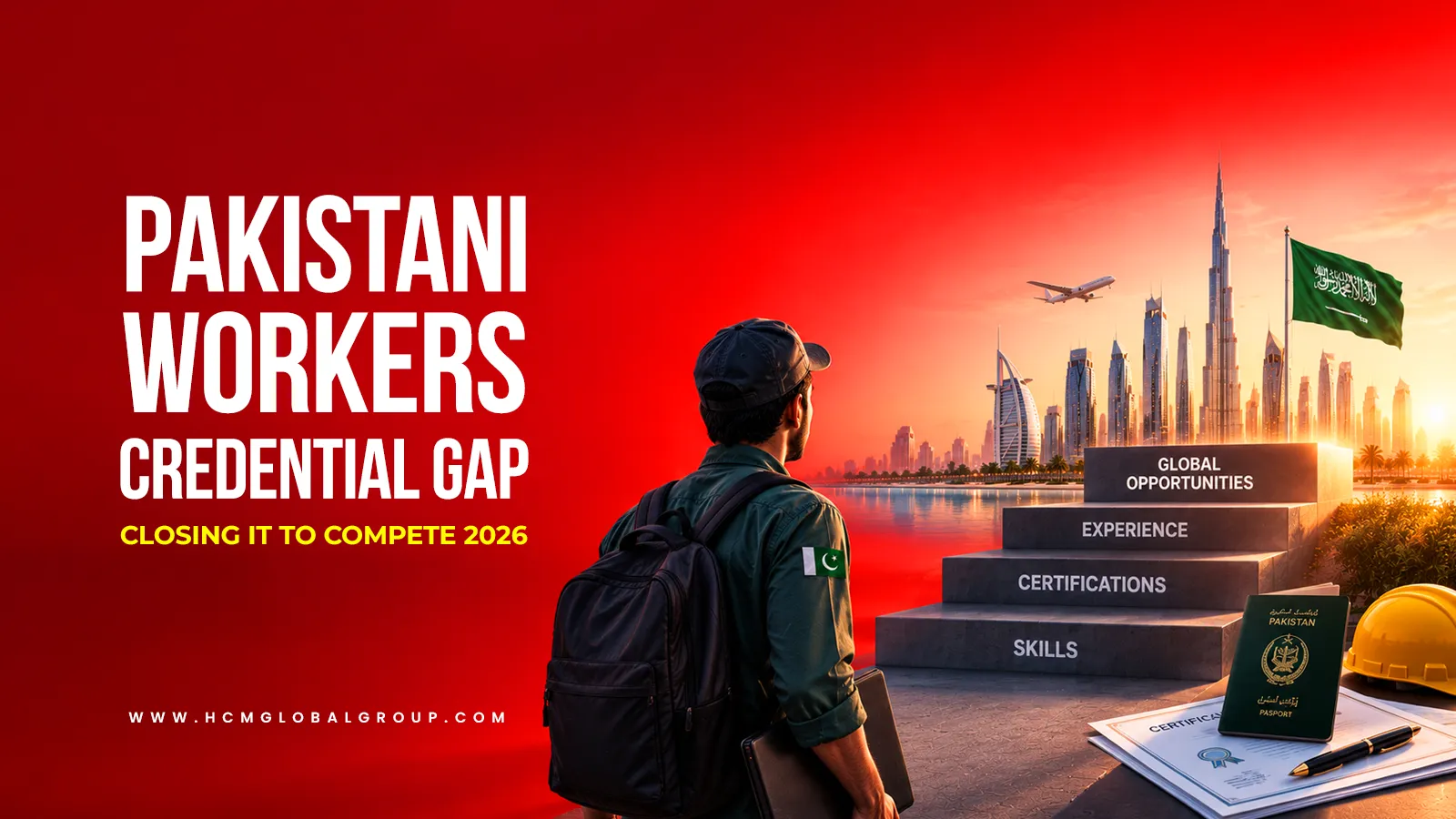
The credential gap is one of the most important, and most misunderstood, challenges facing Pakistani overseas workers in 2026, and closing it is entirely within reach once you understand what it really is. Picture two workers arriving in Riyadh for the same construction project. The Filipino worker arrives with a nationally recognized skill certificate, documented competency assessments, prior Gulf experience, decent English, and a completed pre-departure orientation covering local laws and customs. He is ready to start work immediately. The Pakistani worker arrives with genuine skills and a strong work ethic, but with a local certificate that may not be fully recognized, less structured documentation of his competencies, and less pre-departure preparation. He needs more time and support before he is fully productive.
Both are capable workers, both hardworking, but one arrives placement-ready and the other needs additional certification and integration. This is the credential gap, and it is not about ability. Pakistani workers are just as capable. It is about the systems and preparation that surround them.
This guide honestly examines the credential gap: why Filipino and Indian workers often arrive placement-ready, what Pakistan and individual Pakistani workers from Lahore, Karachi, or Faisalabad can do to close it, and how to compete effectively in the Gulf labor market.
What Is the Credential Gap?
The credential gap refers to the difference in how job-ready workers appear to Gulf employers based on their certification, documentation, and preparation, rather than their actual underlying ability.
A worker who is placement-ready arrives with recognized, verified credentials that Gulf employers trust, documented proof of their skills and competencies, appropriate language ability for their role, prior relevant experience where applicable, and pre-departure orientation about the destination. A worker facing the credential gap may have equal or greater actual skill, but arrives with credentials that are not fully recognized, less structured documentation of their abilities, and less formal preparation.
The Crucial Point
The crucial point about the credential gap is that it is often about perception and systems, not genuine ability. A Pakistani welder may be just as skilled as a Filipino welder, but if the Filipino welder’s skills are certified and documented in a way Gulf employers recognize while the Pakistani welder’s are not, the Filipino worker appears more job-ready. For Gulf employers making hiring decisions, this perceived readiness matters, because it affects who gets hired, who commands better salaries, and who progresses. Closing the credential gap is therefore essential for Pakistani workers to compete on a level playing field.
Why Filipino Workers Often Arrive Placement-Ready
To close the credential gap, we must understand it. Let us look honestly at why Filipino workers are often perceived as placement-ready.
A Structured National Skills System
The Philippines has a structured skills development system through the Technical Education and Skills Development Authority, known as TESDA, which produces technically trained workers through structured training programs and government-accredited institutions. TESDA certifications, known as National Certificates, are issued after workers pass competency assessments, and they are widely recognized in construction trades, healthcare support, and technical maintenance, aligning with the requirements Gulf employers define. This recognized certification is a major advantage that narrows the credential gap for Filipino workers.
Investment, Language, and Preparation
The Philippines invests heavily in this system, strengthening technical and vocational education as a key pillar of national policy, with significant budgets and reforms. In 2026, TESDA priorities include a Digital Skills Passport to document worker competencies and enable employers to verify credentials efficiently. The Philippines also invests in language training, and Filipino workers go through structured pre-departure orientation seminars covering destination labor laws, local customs, and worker rights. The Philippine deployment system also has streamlined, structured documentation procedures. The result is that Filipino workers often arrive with recognized credentials, documented skills, language ability, and preparation, closing the credential gap before they even land.
Why Indian Workers Have Certain Advantages
Indian workers also have certain advantages in the Gulf market that affect the credential gap, though the picture is nuanced.
Scale and Established Pipelines
India has a substantially larger total Gulf employment presence, reflecting its larger population and long employment history, which creates established recruitment pipelines and relationships. Some Gulf employers who have recruited extensively from specific Indian regions have developed default recruitment patterns. It is worth noting honestly that some of this is about familiarity and established relationships rather than genuine quality differences, so the larger Indian presence can be mistaken for a quality preference when it partly reflects simple supply and established pipelines. This matters, because part of the perceived credential gap is about systems and relationships, not worker superiority.
English Proficiency in Some Segments
There is genuine variation in English proficiency across worker populations. Workers from English-medium educational backgrounds, in both India and Pakistan, have an advantage in English-dependent roles. Where Indian workers in certain segments have strong English, this is a real advantage that employers legitimately value. The balanced view is that Indian workers’ advantages come partly from scale and pipelines, partly from genuine strengths like English, and partly from perception, which means Pakistani workers can close the credential gap by addressing the real factors.
The Honest Truth: It Is Not About Pakistani Ability
This point deserves emphasis because it is both true and important for Pakistani workers’ confidence and strategy in closing the credential gap.
The credential gap is not caused by any deficiency in Pakistani workers’ ability. Pakistani workers are skilled, hardworking, and capable, and the same country produces one of the world’s largest communities of online freelancers and sends capable workers across the globe.
Why This Is Good News
The credential gap is caused by systems and preparation, specifically the certification, documentation, language preparation, and pre-departure orientation that surround the worker. These are addressable factors, not fixed limitations. This is genuinely good news, because a gap about systems and preparation rather than ability can be closed. A Pakistani worker who obtains recognized certification, documents their skills properly, prepares their language ability, and completes proper orientation can be just as placement-ready as any Filipino or Indian worker. The task is clear: address the specific, closable factors that create the credential gap.
How Pakistan Can Close the Gap at a National Level
While individual workers can act on their own, the fuller solution to the credential gap also involves national-level improvements, and understanding these helps workers see the bigger picture.
Pakistan needs its vocational certifications to carry international recognition, and progress is being made through NAVTTC and its partnership with Takamol for the Saudi Skill Verification Program, which gives Pakistani workers a route to recognized certification. Pakistan can invest more in structured skills development similar to the Philippines’ TESDA model, strengthen pre-departure orientation to consistently prepare workers, invest in language training particularly in English and Arabic, and build efficient, structured deployment systems and documentation. These national efforts are underway to varying degrees, and continued investment will help close the credential gap over time. But individual workers do not need to wait for national change, because they can act now.
How Individual Pakistani Workers Can Become Placement-Ready
This is the most important section, because closing the credential gap for yourself is fully within your control. Here is how any Pakistani worker can do it.
Get Recognized Certification
The single most important step is obtaining certification that Gulf employers recognize. Use the Skill Verification Program through NAVTTC and Takamol for skilled trades, complete SCFHS and DataFlow for healthcare, and seek internationally recognized certifications for other fields. Recognized certification directly closes the biggest part of the credential gap. Our guide on Pakistani trade certification recognition explains this in detail.
Document Your Skills and Experience Thoroughly
Prepare thorough documentation of your competencies and experience, gathering detailed experience letters, certificates, and references. Well-documented skills help employers see your readiness, and you can use Recognition of Prior Learning to certify skills gained through experience.
Improve Your Language Ability
Invest in your English, and consider basic Arabic for Gulf roles, because strong communication makes you more attractive and more effective. Language ability is a genuine competitive factor you can improve to close the credential gap.
Complete Proper Pre-Departure Preparation
Take pre-departure orientation seriously, understanding your destination’s labor laws, customs, and your rights. Arriving informed makes you more ready and less vulnerable, and it improves your reputation as an organized worker. Our pre-departure checklist guide covers this fully.
Attest Your Documents and Present Yourself Professionally
Ensure your educational and professional documents are properly attested, because attestation makes your qualifications count. Prepare a clear, professional presentation of your skills and background, because a well-organized worker who can clearly demonstrate their qualifications competes far better than one who cannot. By taking these steps, you personally close the credential gap regardless of the pace of national change.
The Payoff: What Closing the Gap Achieves
Understanding the reward makes the effort worthwhile. Closing the credential gap achieves real, tangible benefits.
You become more likely to be hired, as employers favor placement-ready workers. You command better salaries, as recognized skills justify higher pay. You access skilled-tier roles rather than being limited to unskilled work. You compete on equal footing with workers from other countries. You reduce your vulnerability, as skilled, documented workers have more bargaining power. And you open pathways to career progression and better opportunities. In short, closing the credential gap transforms your entire overseas career prospects, turning competing at a disadvantage into competing as an equal, or even a preferred candidate. Given that the credential gap is closable through specific, achievable steps, and given the significant payoff, closing it is one of the smartest investments any Pakistani worker can make.
A Note to Employers
For Gulf employers reading this, there is an important insight worth considering about the credential gap.
Pakistani workers represent excellent value and genuine skill, and the credential gap is often about systems and documentation rather than actual ability. Employers who look beyond surface-level readiness to actual capability, and who invest a little in integrating skilled Pakistani workers, often find excellent, loyal, hardworking employees. Pakistan also offers cost advantages in many categories, with well-established recruitment pipelines and a deep, experienced worker pool. Employers who partner with quality recruitment providers to source and prepare Pakistani workers properly can build strong, cost-effective workforces. The workers are capable, and the opportunity for employers is to see past perception to genuine value.
Common Mistakes Pakistani Workers Make
Mistake 1: Believing the Gap Reflects Inferior Ability
The credential gap is about systems and preparation, not Pakistani ability. Avoid it by recognizing your capability and focusing on the closable factors.
Mistake 2: Skipping Recognized Certification
Without recognized certification, your skills are not visible to employers. Avoid it by obtaining certification through the SVP, SCFHS, or other recognized routes.
Mistake 3: Poor Documentation of Skills
Undocumented skills do not help you appear placement-ready. Avoid it by thoroughly documenting your competencies, experience, and references.
Mistake 4: Neglecting Language Ability
Weak communication limits your roles and appeal. Avoid it by investing in English and basic Arabic for Gulf roles.
Mistake 5: Ignoring Pre-Departure Preparation
Arriving unprepared harms your readiness and reputation. Avoid it by completing proper orientation about your destination.
Mistake 6: Waiting for National Change Instead of Acting Personally
You do not need to wait to close the credential gap for yourself. Avoid it by taking the individual steps to become placement-ready now.
Frequently Asked Questions About the Credential Gap
Q: What is the credential gap?
A: The credential gap is the difference in how job-ready workers appear to Gulf employers based on their certification, documentation, and preparation, rather than their actual ability. Pakistani workers often face this gap despite having strong skills.
Q: Are Pakistani workers less skilled than Filipino or Indian workers?
A: No. The credential gap is not about ability. Pakistani workers are skilled and capable. The gap is about the systems, certification, documentation, and preparation that surround the worker, which are addressable factors.
Q: Why do Filipino workers arrive placement-ready?
A: The Philippines has a structured skills system through TESDA with recognized certifications, invests in language training, provides structured pre-departure orientation, and has efficient deployment systems, which together make Filipino workers appear job-ready.
Q: Do Gulf employers really prefer Indian workers?
A: The picture is nuanced. Some perceived preference reflects India’s larger presence and established pipelines rather than genuine quality differences. Where advantages are real, such as English in some segments, Pakistani workers can compete by addressing the same factors.
Q: How can I become placement-ready as a Pakistani worker?
A: Get recognized certification through the SVP or SCFHS, document your skills thoroughly, improve your English and basic Arabic, complete proper pre-departure preparation, attest your documents, and present yourself professionally to close the credential gap.
Q: What is the single most important step?
A: Obtaining certification that Gulf employers recognize, such as through the Skill Verification Program with NAVTTC and Takamol, or SCFHS for healthcare. Recognized certification closes the biggest part of the credential gap.
Q: Does the credential gap really affect my salary?
A: Yes. Placement-ready workers with recognized credentials command better salaries and access skilled-tier roles, while workers facing the gap are often limited to lower-paid, unskilled positions.
Q: Can I close the gap myself, or do I need to wait for national change?
A: You can close it yourself now. While national improvements help over time, individual workers can become placement-ready through their own certification, documentation, language, and preparation.
Q: How important is language ability?
A: Quite important. Strong English, and basic Arabic for Gulf roles, makes you more attractive and effective, especially in communication-dependent roles. It is a genuine competitive factor you can improve.
Q: What is Recognition of Prior Learning?
A: It is a process to assess and certify skills gained through experience rather than formal training. It helps experienced Pakistani workers get their real skills recognized and documented, closing part of the credential gap.
Q: Is it worth the effort and cost to close the gap?
A: Absolutely. Closing the credential gap makes you more likely to be hired, commands better salaries, opens skilled roles, and reduces vulnerability. Given the closable nature of the gap and the significant payoff, it is a smart investment.
Q: How can HCM Global Group help me become placement-ready?
A: HCM Global Group helps with recognized certification, documentation, attestation, preparation, and connecting you with legitimate employers who value prepared, skilled workers.
How HCM Global Group Helps Pakistani Workers Close the Credential Gap
Closing the credential gap is the key to competing effectively in the Gulf, and HCM Global Group helps Pakistani workers do exactly that.
Certification Guidance
We help you obtain recognized credentials through the Skill Verification Program, SCFHS for healthcare, and other recognized routes that Gulf employers trust.
Documentation and Preparation Support
We help you thoroughly document your skills, experience, and competencies, attest your qualifications properly, and understand your destination so you present yourself as a placement-ready professional.
Recognition of Prior Learning and Job Placement
We help experienced workers certify skills gained through experience, and we connect you with legitimate Gulf employers who value skilled, prepared Pakistani workers, so your readiness translates into real opportunities.
Career Guidance
We help you compete effectively and progress in the Gulf labor market.
Pakistani workers trust HCM Global Group because we understand the credential gap and exactly how to close it, we know that Pakistani workers are capable and we help them show it, and we connect placement-ready workers with employers who value them.
Key Takeaways
The credential gap is the difference in perceived job-readiness based on certification and preparation, not actual ability. Pakistani workers are skilled and capable, and the gap is about systems and preparation, which are closable. Filipino workers arrive placement-ready due to TESDA certification, language training, orientation, and structured systems. Indian workers’ advantages come partly from scale and established pipelines, and partly from perception rather than superiority. Individual Pakistani workers can close the credential gap themselves through recognized certification, documentation, language, and preparation. The single most important step is obtaining certification that Gulf employers recognize. Closing the gap means more hiring, better salaries, skilled roles, and reduced vulnerability. You do not need to wait for national change, because you can become placement-ready now.
The credential gap is real, but it is not a verdict on Pakistani ability. It is a challenge of systems and preparation, and it can be overcome. By taking the specific, achievable steps to become placement-ready, every Pakistani worker can compete on equal footing, and win. Your skills are real, so make them count.
Authority Sources
NAVTTC (National Vocational and Technical Training Commission): navttc.gov.pk
Bureau of Emigration and Overseas Employment (BEOE): www.beoe.gov.pk
Saudi Commission for Health Specialties (SCFHS): www.scfhs.org.sa
Takamol Skill Verification Program: navttc.gov.pk/takamol