
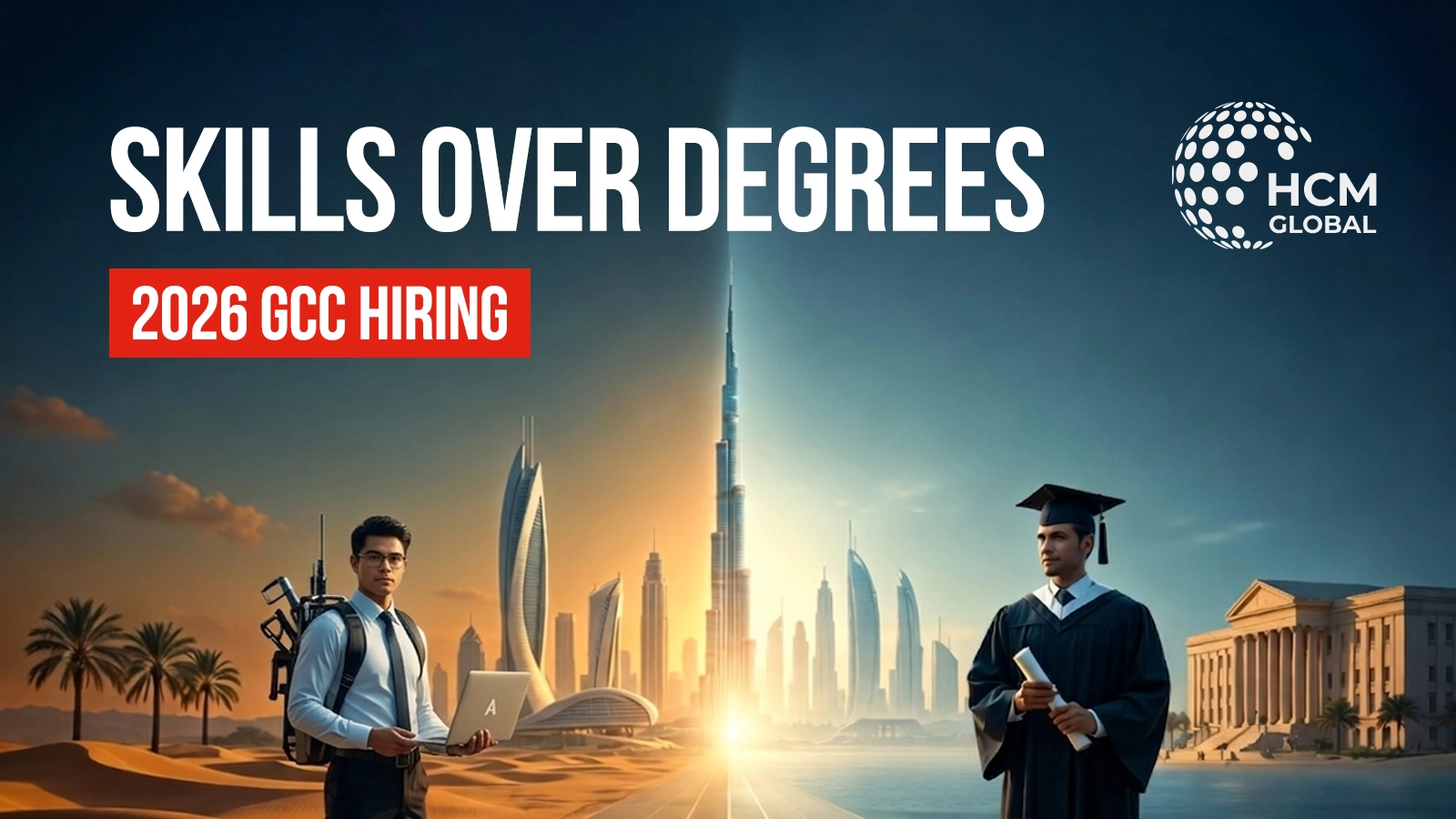
In 2026, skills-based hiring across the GCC is rapidly replacing the traditional degree-first model — and the shift is permanent. Across the UAE, Saudi Arabia, Qatar, and the wider Gulf, employers are no longer asking “where did you study?” as their first question. They are asking “what can you actually do?” This change is reshaping how companies recruit, how candidates position themselves, and how workforce partners like HCM Global Group deliver talent at scale.
If your organisation is still filtering candidates primarily by academic qualifications, you are already falling behind.
What Is Skills-Based Hiring in the GCC?
Skills-based hiring is a recruitment approach that evaluates candidates on demonstrated, verifiable capability rather than formal academic credentials. Instead of screening by degree, employers use competency assessments, trade certifications, practical tests, and scenario-based interviews to identify the right fit for a role.
Skills-based hiring is growing fast in 2026 because it works. Instead of filtering candidates by credentials, employers are testing for actual capabilities — and talent acquisition specialists in Dubai are finding strong candidates who were previously overlooked as hiring shifts away from rigid credentials toward real-world capability.
Why Skills-Based Hiring in the GCC Is Growing So Fast
Several forces are driving this shift simultaneously across the Gulf region.
The scale of hiring demand is the first factor. The UAE currently ranks number one globally in hiring optimism for 2026 with a Net Employment Outlook of +48%, while the broader GCC region is projected to create over 5 million new private-sector jobs by 2030. At that volume, employers simply cannot sustain slow, credential-heavy screening processes.
The talent gap is the second pressure. A significant 90% of organisations across the GCC reported skills gaps in 2025, with high competition for talent and lack of career progression cited as leading causes. The problem is not a shortage of people — it is a mismatch between how employers screen and where qualified talent actually exists.
Nationalisation programs are the third driver. Traditional hiring approaches that rely heavily on degrees or international experience can unintentionally limit local candidates, because the local talent pool may not always hold the exact formal credentials employers historically demanded. Yet their demonstrable skills in IT, project management, customer service, or digital marketing can qualify them for critical roles. Skills-based hiring directly supports Emiratisation and Saudization by widening access to national talent. In the UAE, Emiratisation targets for skilled roles have increased to 10%, with 42% of companies planning to grow Emirati headcount in 2026. In Saudi Arabia, 93% of employers currently employ Saudi nationals, and 75% plan further increases this year.
How Gulf Employers Are Applying Skills-Based Hiring GCC Practices
Gulf employers are increasingly prioritising verifiable skills, trade certifications, and practical experience over formal academic qualifications — creating new opportunities for workers with technical and vocational training, particularly in construction, electrical works, and industrial operations.
In knowledge-based sectors, the shift follows the same logic but looks different. Hiring managers in 2026 increasingly prefer candidates who blend strong domain expertise — in areas such as finance, healthcare, or supply chain — with essential technical skills. Data literacy, automation knowledge, and familiarity with AI tools are becoming key differentiators.
Interview processes are evolving accordingly. Interview frameworks increasingly include scenario-based assessments, problem discussions, and real-world simulations instead of purely technical questioning. The goal is to understand how a candidate performs under realistic conditions — not just what their CV says they have studied.
Many organisations are now breaking work into capability clusters — AI and data, cloud and security, product and UX, or finance and analytics — and staffing around these blended skill sets rather than filling narrow role labels.
The Business Case for Skills-Based Hiring in the Gulf
Beyond expanding the talent pool, skills-based hiring delivers measurable operational results. By focusing on capabilities rather than credentials, employers reduce onboarding time and gain access to ready-to-contribute talent that meets urgent staffing needs more efficiently.
Strategically, hiring success in 2026 depends less on volume and more on alignment between business intent, talent capability, and long-term workforce design. Organisations that align hiring decisions with future capability needs are better prepared for shifts in technology, operating models, and global priorities — enabling smoother scaling, stronger leadership pipelines, and sustained delivery.
Organisations that track skills-based hiring, data-led decisions, and flexible work models build stronger, steadier teams faster than those relying on brand pull or academic filtering alone.
What Job Seekers in the UAE and Saudi Arabia Need to Know
For professionals targeting roles across the GCC, the message is direct: your skills matter more than your degree title in 2026.
Candidates who demonstrate the ability to collaborate across multicultural teams, handle fast-paced project environments, and deliver results under evolving conditions have significantly stronger prospects in the Gulf job market this year. Certifications in high-demand areas — cloud computing, project management, data analytics, cybersecurity — carry real weight with employers today.
Update your CV to lead with measurable outcomes and demonstrated competencies rather than listing qualifications. Highlight certifications, practical project results, and cross-functional experience. Your academic background remains relevant, but it is no longer the deciding factor.
How HCM Global Group Supports Skills-Based Recruitment Across the GCC
At HCM Global Group, our recruitment methodology across the UAE, Saudi Arabia, and Qatar is built around matching verified talent to specific operational requirements. Whether supporting a large-scale industrial mobilisation or an executive search for a regional headquarters, we screen and deliver candidates based on capability — not just credentials.
We work with clients to define the actual skills and competencies a role demands, then source, assess, and place talent that meets those benchmarks. For organisations navigating Emiratisation and Saudization requirements, our deep local market networks help identify national talent aligned to high-value roles.
If your organisation is ready to move beyond degree-first hiring and build a workforce around real capability, contact HCM Global Group today.